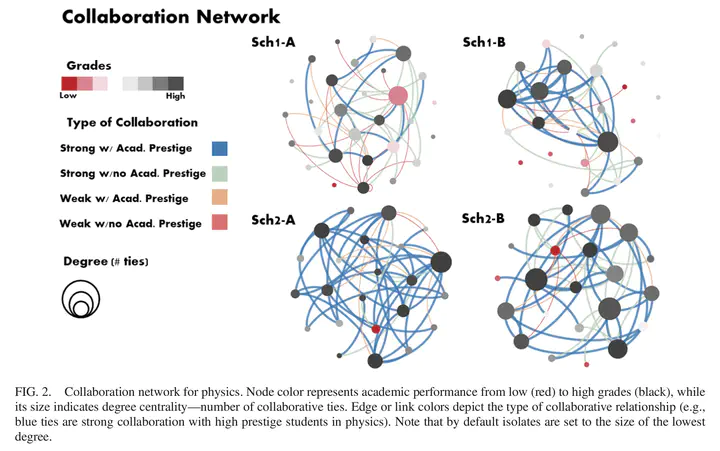
 Image credit: CRiSS-LAB
Abstract
Group configurations shape social skills and learning outcomes. This study compares random allocation with student self-selection in high school physics groups, showing that self-selected groups develop stronger friendship bonds and stability, while randomly formed groups show greater cooperation and membership change.
Type
Publication
Physical Review Physics Education Research, 21, 010157
Diego Ramirez
Ph.D. Candidate
Javier Pulgar
Physics Department, Universidad del Bío Bío
Cristian Candia
Associate Professor, Data Science Institute, School of Engineering, Universidad del Desarrollo, Chile. Director of CRiSS-LAB.
Cristian Candia is a computational social scientist studying human and collective behavior with large-scale data, network science, experiments, and AI.