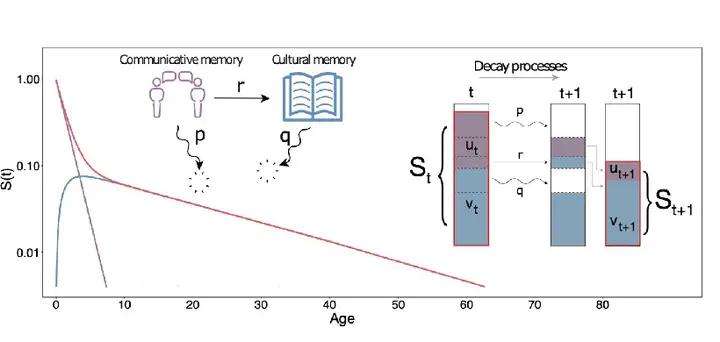
 Figure from the article
Abstract
This preprint models collective memory as a two-step decay process in which short-lived communicative memory and long-lived cultural memory sustain different temporal regimes of collective attention. The model predicts when cultural memory overtakes communicative memory and highlights policy-relevant implications for public problems.
Type
Publication
arXiv

Cristian Candia
Associate Professor, Data Science Institute, School of Engineering, Universidad del Desarrollo, Chile. Director of CRiSS-LAB.
Cristian Candia is a computational social scientist studying human and collective behavior with large-scale data, network science, experiments, and AI.