Linking physical violence to women’s mobility in Chile
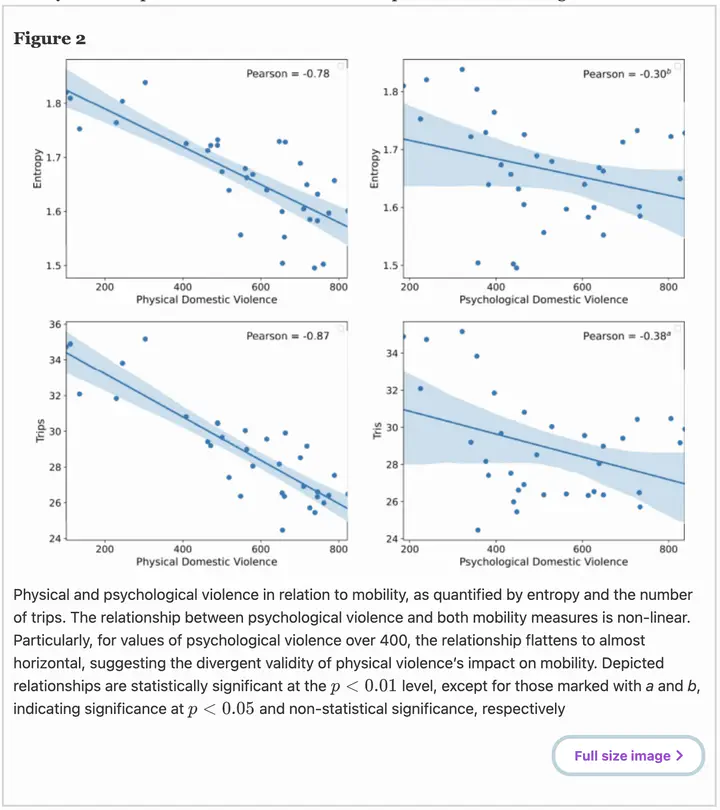 Image credit: CRiSS-LAB
Abstract
Despite increased global attention on violence against women, understanding the factors that lead to women becoming victims remains a critical challenge. Notably, the impact of domestic violence on women’s mobility—a critical determinant of their social and economic independence—has remained largely unexplored. This study bridges this gap, employing police records to quantify physical and psychological domestic violence, while leveraging mobile phone data to proxy women’s mobility. Our analyses reveal a negative correlation between physical violence and female mobility, an association that withstands robustness checks, including controls for economic independence variables like education, employment, and occupational segregation, bootstrapping of the data set, and applying a generalized propensity score matching identification strategy. The study emphasizes the potential causal role of physical violence on decreased female mobility, asserting the value of interdisciplinary research in exploring such multifaceted social phenomena to open avenues for preventive measures. The implications of this research extend into the realm of public policy and intervention development, offering new strategies to combat and ultimately eradicate domestic violence against women, thereby contributing to wider efforts toward gender equity.

Cristian Candia
Associate Professor, Data Science Institute, School of Engineering, Universidad del Desarrollo, Chile. Director of CRiSS-LAB.
Cristian Candia is a computational social scientist studying human and collective behavior with large-scale data, network science, experiments, and AI.

Loreto Bravo
Directora Instituto de Data Science, Facultad de Ingeniería, Universidad del Desarrollo.