Autism shapes social integration and reciprocity in elementary classrooms
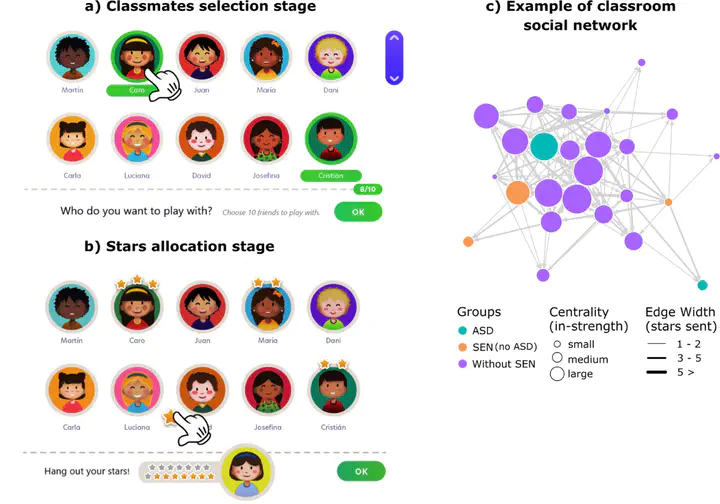 Image credit: CRiSS-LAB
Abstract
This study examines social dynamics in elementary classrooms using experimental game theory and social network analysis. Across 26 classrooms and 625 students, the analysis shows that autistic children and children with special educational needs are less central and less involved in reciprocal peer relationships than students without special educational needs, highlighting the importance of evidence-based approaches to social inclusion.
Type
Publication
Scientific Reports, 15, 40473

Melanie Oyarzún
Research Scientist

Cristian Candia
Associate Professor, Data Science Institute, School of Engineering, Universidad del Desarrollo, Chile. Director of CRiSS-LAB.
Cristian Candia is a computational social scientist studying human and collective behavior with large-scale data, network science, experiments, and AI.