From Co-Location Patterns to an Informal Social Network of Gig Economy Workers
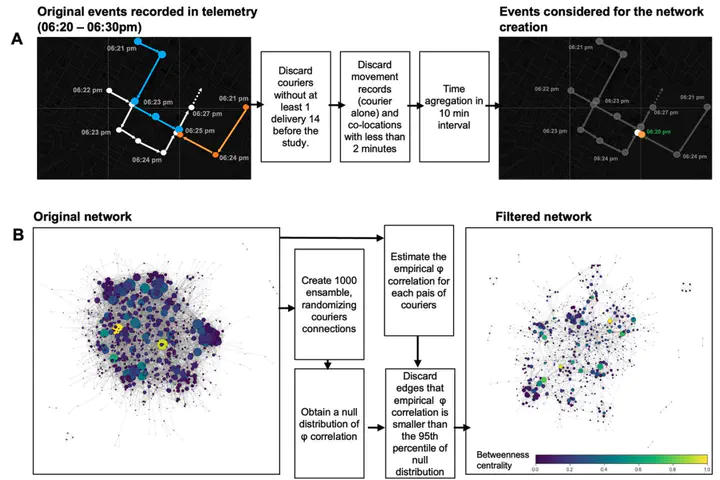 Image credit: CRiSS-LAB
Resumen
The labor market has transformed with the advent of the gig economy, characterized by short-term and fexible work arrangements facilitated by online platforms. As this trend becomes increasingly prevalent, it presents unique opportunities and challenges. In this manuscript, we comprehensively characterize the social networks of gig economy workers in each of the 15 cities studied. Our analysis reveals a scaling relationship between networks and the city population. In particular, we note the high level of modularity of the networks, and we argue that it results from the natural specialization of couriers along diferent areas of the cities. Furthermore, we show that degree and betweenness centrality is positively correlated with income but not with tenure. Our fndings shed new light on the social organization of the gig economy workers and provide valuable insights for the management and design of gig economy platforms.

Cristian Candia
Profesor Asociado, Instituto de Data Science, Facultad de Ingeniería, Universidad del Desarrollo, Chile. Director de CRiSS-LAB.
Cristian Candia es científico social computacional y estudia el comportamiento humano y colectivo usando datos a gran escala, ciencia de redes, experimentos e inteligencia artificial.