Scaling behavior of public procurement activity
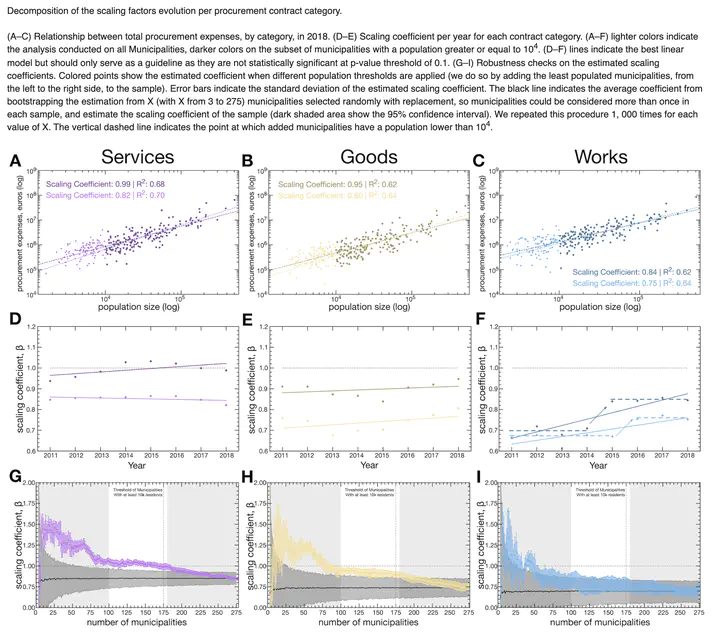 Image credit: CRiSS-LAB
Resumen
Public procurement refers to the purchase by public sector entities—such as government departments or local authorities—of Services, Goods, or Works. It accounts for a significant share of OECD countries’ expenditures. However, while governments are expected to execute them as efficiently as possible, there is a lack of methodologies for an adequate comparison of procurement activity between institutions at different scales, which represents a challenge for policymakers and academics. Here, we propose using methods borrowed from urban scaling laws literature to study public procurement activity among 278 Portuguese municipalities between 2011 and 2018. We find that public procurement expenditure scales sublinearly with population size, indicating an economy of scale for public spending as cities increase their population size. Moreover, when looking at the municipal Scale-Adjusted Indicators (the deviations from the scaling law) by contract categories—Works, Goods, and Services—we are able to identify a richer local characterisation of municipalities based on the similarity of procurement activity. These results make up a framework for quantitatively studying local public expenditure by enabling policymakers a more appropriate foundation for comparative analysis.

Cristian Candia
Profesor Asociado, Instituto de Data Science, Facultad de Ingeniería, Universidad del Desarrollo, Chile. Director de CRiSS-LAB.
Cristian Candia es científico social computacional y estudia el comportamiento humano y colectivo usando datos a gran escala, ciencia de redes, experimentos e inteligencia artificial.