 Image credit: CRiSS-LAB
Resumen
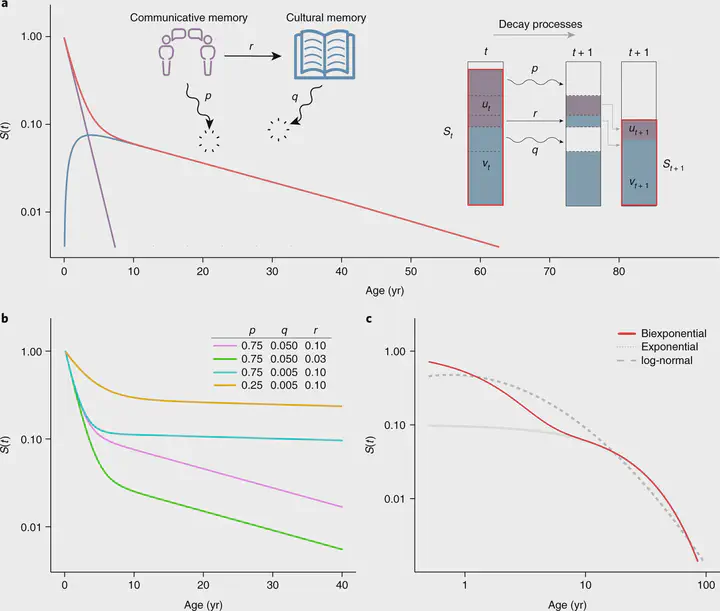
Collective memory and attention are sustained by two channels oral communication (communicative memory) and the physical recording of information (cultural memory). Here, we use data on the citation of academic articles and patents, and on the online attention received by songs, movies and biographies, to describe the temporal decay of the attention received by cultural products. We show that, once we isolate the temporal dimension of the decay, the attention received by cultural products decays following a universal biexponential function. We explain this universality by proposing a mathematical model based on communicative and cultural memory, which fits the data better than previously proposed log-normal and exponential models. Our results reveal that biographies remain in our communicative memory the longest (20–30 years) and music the shortest (about 5.6 years). These findings show that the average attention received by cultural products decays following a universal biexponential function.

Cristian Candia
Profesor Asociado, Instituto de Data Science, Facultad de Ingeniería, Universidad del Desarrollo, Chile. Director de CRiSS-LAB.
Cristian Candia es científico social computacional y estudia el comportamiento humano y colectivo usando datos a gran escala, ciencia de redes, experimentos e inteligencia artificial.

Cristián Jara-Figueroa
Director de Advanced Insights and Modeling en Cash App

Carlos Rodriguez-Sickert
Universidad del Desarrollo.

Lászlo Barabási
Profesor Robert Gray Dodge de Ciencia de Redes en Northeastern University