 Image credit: CRiSS-LAB
Resumen
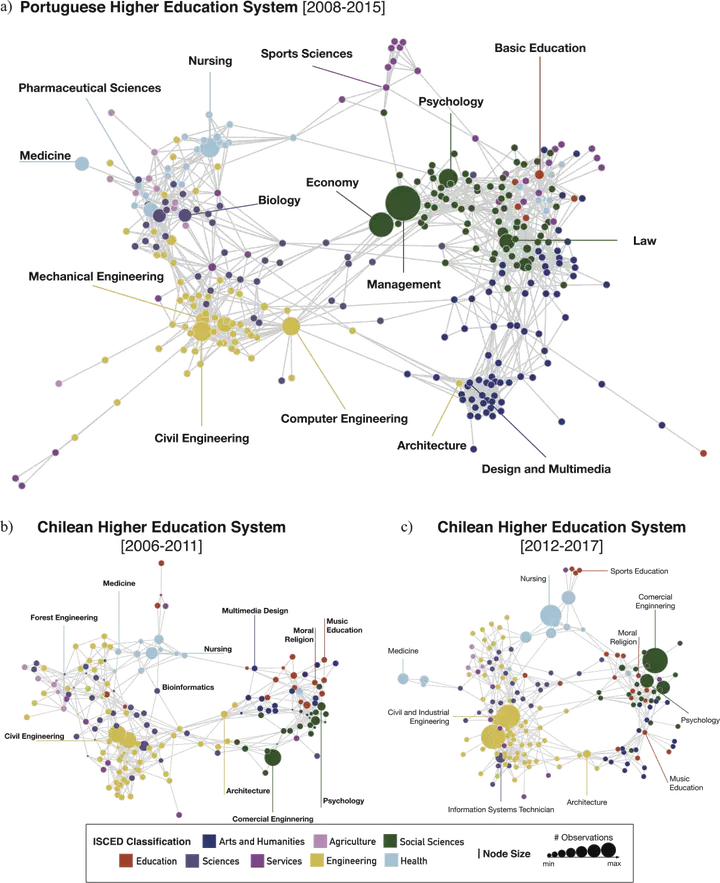
Data on the applicants’ revealed preferences when entering higher education is used as a proxy to build the Higher Education Space (HES) of Portugal (2008–2015) and Chile (2006–2017). The HES is a network that connects pairs of degree programs according to their co-occurrence in the applicants’ preferences. We show that both HES network structures reveal the existence of positive assortment in features such as gender balance, application scores, unemployment levels, academic demand/supply ratio, geographical mobility, and first-year drop-out rates. For instance, if a degree program exhibits a high prevalence of female candidates, its nearest degree programs in the HES will also tend to exhibit a higher prevalence when compared to the prevalence in the entire system. These patterns extend up to two or three links of separation, vanishing, or inverting for increasing distances. Moreover, we show that for demand/supply ratio and application scores a similar pattern occurs for time variations. Finally, we provide evidence that information embedded in the HES is not accessible by merely considering the features of degree programs independently. These findings contribute to a better understanding of the higher education systems at revealing and leveraging its non-trivial underlying organizing principles. To the best of our knowledge, this is the first network science approach for improving decision-making and governance in higher education systems.

Cristian Candia
Profesor Asociado, Instituto de Data Science, Facultad de Ingeniería, Universidad del Desarrollo, Chile. Director de CRiSS-LAB.
Cristian Candia es científico social computacional y estudia el comportamiento humano y colectivo usando datos a gran escala, ciencia de redes, experimentos e inteligencia artificial.