Reusing research data: Why clarity, responsibility, and rigor matter [Opinion]
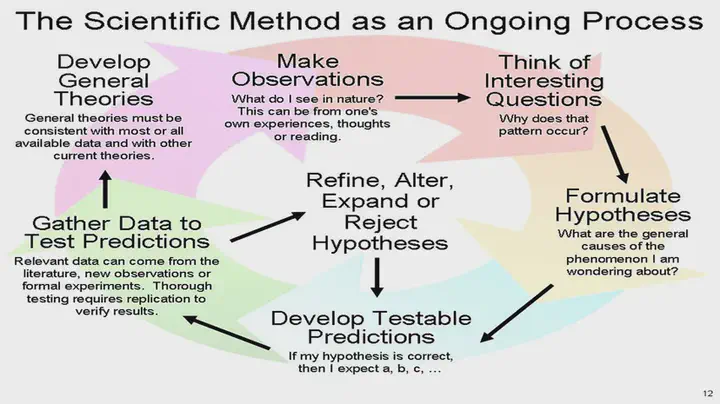 Image credit: The steps of the scientific method. Wikimedia Commons (CC BY-SA 4.0).
English version of the original Spanish commentary.
A note on where I am coming from
I am not an expert on human evolution or on how evidence in the field is reviewed and published. This is my own opinion. A recent paper made me wonder how confidently we can generalize from records collected for other purposes. I want studies like this to be published. I also want their limitations to be made clear, with statistical checks that let readers judge how much weight the evidence can bear.
What the paper reports
The familiar picture of men hunting and women gathering has been questioned for decades. Since the 1960s, researchers have presented evidence of the importance of foods gathered by women. Later ethnographic accounts documented a wider range of activities, including hunting by women.
Anderson and colleagues’ 2023 paper, The Myth of Man the Hunter, revisits the division of labor using ethnographic reports. In 50 of the 63 societies with explicit hunting records, the authors found documentation of women hunting. Of the 41 cases where intentionality could be assessed, 36 described women hunting intentionally. The accounts describe different prey across societies. This is evidence against a simple story in which women only gathered and men alone hunted. The tabulation is useful. My question is whether it tells us how common intentional hunting by women was across hunter-gatherer societies.
What changes when we track the denominator
The underlying work draws on material assembled in D-PLACE, the Database of Places, Language, Culture, and Environment. These are valuable records, but they were not collected to answer this particular question. Here is how the available descriptions narrow.
| Step | Societies | % of 1,400 documented | % of 391 selected | % of 63 with explicit hunting data |
|---|---|---|---|---|
| Hunter-gatherer societies selected | 391 | 27.9 | 100 | — |
| Explicit records about hunting | 63 | 4.5 | 16.1 | 100 |
| Records documenting women hunting | 50 | 3.6 | 12.8 | 79.4 |
| Records describing whether women’s hunting was intentional or opportunistic | 41 | 2.9 | 10.5 | 65.1 |
| Records describing size of animals hunted by women | 45 | 3.2 | 11.5 | 71.4 |
| Documented outcome | Societies | % of 1,400 | % of 391 | % of 63 | % of 50 | % of 41 |
|---|---|---|---|---|---|---|
| Women’s hunting described as intentional | 36 | 2.6 | 9.2 | 57.1 | 72 | 87.8 |
| Women hunted small prey | 21 | 1.5 | 5.4 | 33.3 | 42 | 51.2 |
| Women hunted medium prey | 7 | 0.5 | 1.8 | 11.1 | 14 | 17.1 |
| Women hunted large prey | 15 | 1.1 | 3.8 | 23.8 | 30 | 36.6 |
| Women hunted prey of all sizes | 2 | 0.1 | 0.5 | 3.2 | 4 | 4.9 |
| Women hunted with dogs and/or children | 23 | 1.6 | 5.9 | 36.5 | 46 | 56.1 |
Tables: my tabulation from the paper. The columns change the denominator, not the underlying counts. The last column is the intentionality denominator, not a separately defined prey or hunting-companion sample.
The 87.8% describes 36 of 41 societies where a record lets us assess intent. It does not estimate what happened in societies without such a record. Conversely, the 2.6% across all documented societies is a coverage comparison and should not be read as the prevalence of intentional hunting. I could not establish from the paper exactly how the broader selection of 391 was made. If I missed a description, I would welcome a correction.
The key issue is not just that the final sample is small. It is how observations make it into the sample. If an ethnographer was more likely to record women hunting where the practice was salient, the recorded cases could give an inflated impression of its frequency. Conversely, an ethnographer who assumed men were the hunters may have overlooked women’s work. Without knowing what went unrecorded and why, the data cannot settle how representative these cases are. Even among the documented cases, “intentional” and “opportunistic” may not capture the variety of practices.
What we can build from this
I would treat the study as a useful set of observations that motivates the next round of research. It would be valuable to return to the underlying ethnographies, make the inclusion and coding rules explicit, and collect evidence designed to answer questions such as when women deliberately hunted large animals. Those steps could tell us which findings generalize and where the answer varies.
The presence of women in the hunting records matters. How often they hunted, under what conditions, and how well those practices were documented are different questions. A headline can make them sound like one. Our job as researchers is to keep them separate and communicate what the evidence warrants. As my grandfather used to say, a lot of words and little evidence make for bad science.
References

Cristian Candia
Associate Professor, Data Science Institute, School of Engineering, Universidad del Desarrollo, Chile. Director of CRiSS-LAB.
Cristian Candia is a computational social scientist studying human and collective behavior with large-scale data, network science, experiments, and AI.