Human and collective behavior
Memory, attention, cooperation, learning, preferences, social interaction, and decision-making across individuals and groups.
View researchCRiSS-LAB combines computational social science, network science, experiments, and AI to understand how people interact, learn, remember, cooperate, form preferences, and make decisions.
From collective memory and online behavior to education, institutions, and human–AI systems, we connect fundamental research with tools and evidence for real-world problems.
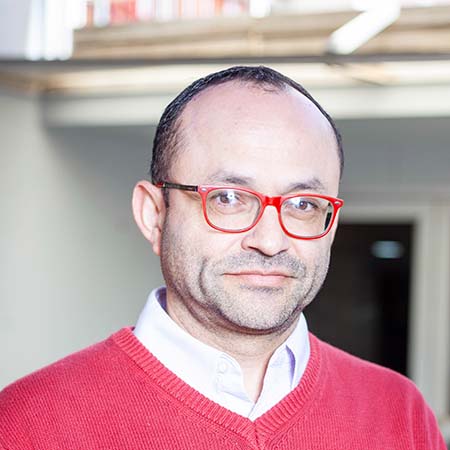
CRiSS-LAB is an interdisciplinary computational social science laboratory at Universidad del Desarrollo in Santiago, Chile, directed by Cristian Candia, Ph.D. We study human behavior and social systems using large-scale data, experiments, network science, statistical modeling, causal inference, and artificial intelligence.
Our research spans collective memory and attention, cooperation and learning, social networks, preferences and decision-making, computational models of human heterogeneity, and the interaction between people and AI. We also turn research into applied platforms and evidence for education, science, organizations, public-interest technology, and other real-world settings.
Cristian Candia, Ph.D.
Director of CRiSS-LAB.
What we study
We use computation, experiments, networks, and artificial intelligence to study how human behavior scales into patterns across groups, institutions, and societies.
Memory, attention, cooperation, learning, preferences, social interaction, and decision-making across individuals and groups.
View researchHow computational models and AI capture human judgments, heterogeneity, systematic errors, and collective preferences.
View research lineWe connect fundamental research with education, science, organizations, public debate, markets, and digital platforms.
View projectsPeople Behind CRiSS-LAB
Our team connects theory, data, and applied technology to study collective memory, learning, cooperation, and decision-making in real social systems.







![Boundaries of Belonging in Memory, Politics, and Schools [Keynote]](https://ingenieria.udd.cl/files/2025/09/key3-1366x768.jpg)
![Neural Network Nominate: Mapping Mass Political Ideology via Revealed Preferences [Best Lightning Talk Award]](https://ingenieria.udd.cl/files/2025/09/award3-1366x768.jpg)
![Complexity Global School for Emerging Political Economies 2025 [Invited Faculty]](https://sfi-edu.s3.amazonaws.com/sfi-edu/production/uploads/edu_gallery/20240722_141528467_iOS_ae02c8.jpg.1800x1200_q85_box-0%2C175%2C4032%2C2863_replace_alpha-%23FFFFFF_upscale.jpg)
![Quantifying student behavioral patterns and roommate peer effects [Charla Virtual]](/event/talk23_jiangao/featured_hua42755a3d6aa1d3e0341c6617544d8df_54828_150x0_resize_q75_h2_lanczos.webp)
![Social Networks Predict the Emergence of Technologies. [Virtual Talk]](/event/talk22_blengyel/featured_hu0985bdcf8bd79ae184ca9f0c8e883cf8_33818_150x0_resize_q75_h2_lanczos.webp)
![Contextualized Construct Representation: Leveraging Psychometric Scales to Advance Theory-Driven Text Analysis. [Virtual Talk]](/event/talk21_mattari/featured_hu041b05810bb990a81370a2d1e6c39a98_6087_150x0_resize_q75_h2_lanczos.webp)